
Showing posts with label rig. Show all posts
Showing posts with label rig. Show all posts
Saturday, 15 October 2016
Making a Gopro Hero Rig For Filming Fishing Lures Underwater Paul Adams Paul Adams
That is one big title but i think it says it all.


Tuesday, 7 April 2015
Wednesday, 18 July 2012
How to tie Mackerel Feather Rigs (the Movie)
Another ‘how to’ video, this time it's mackerel feather rigs in time for the summer’s bounty of the little striped monsters.
Saturday, 9 June 2012
Wagglers

Image Above: Roach and home made balsa waggler float.
Despite the weather summer has arrived at the lake; the stretches of water cleared by the winter die back of weed have gradually shrunk under the season’s new growth. Even bank space is at a premium as anglers have returned from hibernation in public houses or curled up under the warm glow of a T.V. sets. There is little open water in which to throw a lure and so I have my excuses to fish with floats and bait.
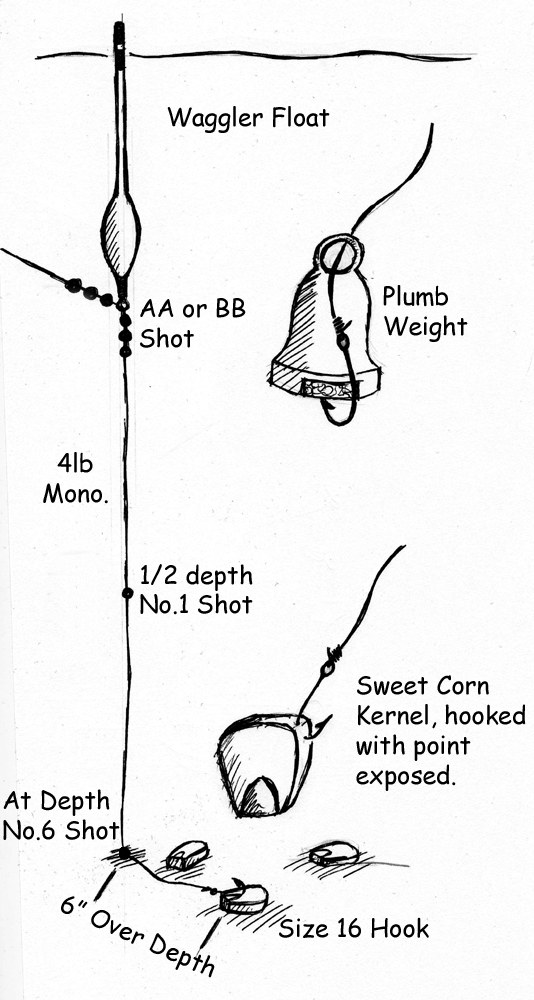
I cast and wind in stopping every few feet to check the depths, if the float disappears under the weight of the plumb the length between the float and hook is under depth, if the float lies flat on the surface I am over depth. From my plotting’s I work out that the bottom falls away sharply to a pretty constant depth only a short way out. I cast again and bring the float back to my chosen fishing position just beyond the drop off and the float sinks until its top creates the slightest lump in the surface tension; I am just on depth at about five feet. Once retrieved I unhook the plumb weight and move the small shot weights that hold the float in position and the float six inches up the line over depth so the hook will lie on the bottom rather than hang mid water like an apparition.
I take four of the larger split shot weights from my selection box and pinch them on the line either side of the float and then drop it in the water. The float stands upright with the water covering three quarters of its length, I add another smaller shot half way between the float and the hook and a much finer one six inches from the hook. When I cast again to deeper water the float settles until only half an inch shows above the surface enough to hold its own in amongst the ripples surface but still show a bite. The float is traditional waggler with a bulb of balsa at its base, the design keeps the float relativity still even when the surface of the lake is bruised by ripples. I am ready to fish.
I hook on a single sweet corn kernel and cast again following it with a handful of loose kernels thrown around the float. The fish come in short bursts mainly roach of a good size and skimmers (small bream). As afternoon turns to evening the sky darkens prematurely and my rain filled bait box takes on the look of sweet corn chowder. I realise it is time to leave when I begin cradling fish for warmth and wondering whether wading in the lake may be the drier option.

Wednesday, 22 February 2012
Fishing the big Murky (Mersey)

Image Above: A rod at rest on the River Mersey.
Image below left: 2 Hook Flapper Rig
The tide has past exhausting itself amongst the flats and
concrete elbows of the inner estuary. The deep, mud laden waters of the river pause
as if contemplating their next move.
 I lean on the promenade rail in the sun feeling
the warmth drain from me in the chill breeze. A line is out from a rod propped
on the handlebar grips of my by bicycle. I close one eye and line the rod tip
up with the corner of one of the giant sheds of a shipyard on the far bank. The
tip traces a diagonal route over the cladding, down to the river and back
marking a gentle breath and exhalation as the tension of each passing wavelet is
transmitted through the taught line to the rod.
I lean on the promenade rail in the sun feeling
the warmth drain from me in the chill breeze. A line is out from a rod propped
on the handlebar grips of my by bicycle. I close one eye and line the rod tip
up with the corner of one of the giant sheds of a shipyard on the far bank. The
tip traces a diagonal route over the cladding, down to the river and back
marking a gentle breath and exhalation as the tension of each passing wavelet is
transmitted through the taught line to the rod.
The line is anchored
into the riverbed by a spiked weight and a little above, two junctions carry
short lengths to baited hooks that would ordinarily flap in the current, hence
the name ‘flapper rig’. I tied the rig
last night as part of the preparations that have found their way into the ritual
of a fishing trip. Other preparations included a trip to the tackle shop to buy
line and pick brains.
The owner is never fearful of handing out advice despite the
audience of misplaced fishermen that hang about ready to argue for
some other rig, rod or just something else. I tell him about the tide carrying
my weights off when I cast. He tells me not to let any more line out once the
weight hits the water and that slack line will just act like a spinnaker giving
the tide more leverage over the weight. He tells me other things as well and
the stories build until only fishing and fish matter and everything else is
pushed into the gaps.
I buy mackerel from the fish counter in the supermarket
and the sales assistant asks me if I am going fishing, I laugh and ask is it only
fishermen looking for bait who shop here, he doesn’t answer.
I was away early this morning before the cars filled up the
shopping streets hiding the takeaway cartons and cigarette butts that fill the
gutters.
The river is moving again and I am reminded that I am
fishing the shipping lane by the prow of a vessel that is folding back the
water as it pushes on upstream.
Monday, 12 December 2011
T.I.Y. tie it yourself

Image Left: Homemade Tinsel Rig Lures (awaiting rigging)
I had day off island today and visited Oban, the nearest mainland port. As well as running errands for fellow islanders I got to visit the tackle shop. Despite spending far too much time making my own tackle I really enjoy browsing through the racks of readymade lures. It would seem that the biggest advances in mass produced fishing lures are largely limited to the packaging, I wondered if some the companies would have been better attaching hooks to the wrapper and throwing the contents away.
My real interest was in the feather rigs, not to buy them but more to check up on the competition. As I mainly fish with feather rigs and of course tie my own I wanted to see if the quality was comparable with store bought varieties and also check prices. I was a little disappointed that some of world’s major tackle manufactures were producing what could only be described as crap, but also I little happier about my own rigs. Over the last few of years I have pulled a few thousand fish out the seas around the island using home-made feather rigs so maybe it’s about time I starting making them to sell, so that is the plan.
Saturday, 5 November 2011
Homemade mackerel feathers

Image Above: Homemade Mackerel feathers
Luckily today I found an hour between transporting people on and off the island to get in a bit of boat fishing. Realising the time constraints and the fact that a swell was still breaking heavily in the sound of Iona I stayed in the shelter of Easter Island fishing a reef that runs in a line from the island’s pier out into the sound.
No bait this time just homemade feather rigs jigged off the bottom. It didn`t take to find a shoal of baby pollock and cod. I moved into deeper water in an effort to find some large fish and struck into some saithe that were just on eating size. The real reason for the trip was to test out some rigs I had bonded rather than tied and then held with no problems even after a few encounters with kelp.
I am still waiting for a good calm day to get a little further out where the big fish live and really test some homemade tackle.
Image Below: Saithe (coal fish) caught on homemade feather rigs

Subscribe to:
Posts (Atom)